



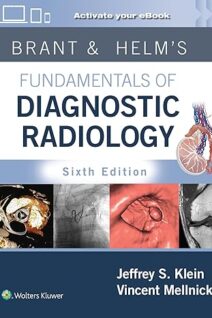

Brant & Helm's Fundamentals of Diagnostic Radiology: Print + eBook with Multimedia Sixth edition
Original price was: 340.86 €.305.07 €Current price is: 305.07 €.
ISBN: 9781975199005
Publication Month: September, 2024
Edition: 6
Product Format: Hardcover
Height x Width: 0.000 x 0.000
Weight: 4.467 kg
Number of pages: 1600 pages
Imprint: LWW
Publisher: LWW
Available on backorder
Brant & Helm's Fundamentals of Diagnostic Radiology: Print + eBook with Multimedia
Sixth edition
Long considered a leading text in the field, Brant & Helm's Fundamentals of Diagnostic Radiology, 6th Edition, provides essential coverage for radiology residents, interns, students, and practitioners. Drs. Jeffrey S. Klein and Vincent Mellnick lead a team of expert section editors who cover all subspecialty areas including neuroradiology, chest, breast, abdominal, musculoskeletal imaging, ultrasound, pediatric imaging, interventional techniques, and nuclear radiology. Full-color images, updated content, self-assessment tools, and online resources make this text ideal for reference and review.
- Offers a comprehensive, system-based overview of today's imaging, including anatomy, physiology, imaging techniques, and disease processes
- Contains numerous high-quality images with comprehensive captions
- Provides access to interactive image flash cards online—perfect for chapter-by-chapter self-assessment
- Includes fully revised sections on abdominal imaging that reflects the current curriculum
Enrich your eBook reading experience
- Read directly on your preferred device(s),such as computer, tablet, or smartphone.
- Easily convert to audiobook,powering your content with natural language text-to-speech.
*********************************
Brant & Helm's Fundamentals of Diagnostic Radiology is a widely recognized textbook designed for medical students, radiology technicians, and other healthcare professionals who want to gain a solid understanding of the fundamentals of diagnostic radiology. Edited by leading experts in the field, the textbook provides a comprehensive overview of various imaging techniques, their anatomical basis, and their clinical applications.
The textbook is divided into several parts, each focusing on a specific area of diagnostic radiology. The first part, "Introduction to Diagnostic Radiology," provides a general overview of the discipline, including the history, ethics, and principles of diagnostic imaging. It also discusses the role of diagnostic radiology in modern medicine and its importance in providing quality patient care.
The second part, "Fundamentals of Anatomy," provides a detailed overview of human anatomy, necessary for understanding imaging techniques. It covers various body systems, including the skeletal, muscular, nervous, circulatory, respiratory, digestive, excretory, and reproductive systems. Each chapter includes illustrations and diagrams that help readers visualize anatomical structures and their relationships.
The third part, “Fundamentals of Imaging,” provides an overview of various imaging techniques, including radiology, computed tomography, magnetic resonance imaging, ultrasound, positron emission tomography (PET) scanning, and magnetic resonance imaging (MRI). It also discusses the principles of contrast agents, image acquisition techniques, and image postprocessing.
The fourth part, “Thoracic Imaging,” focuses on various thoracic procedures, such as chest radiography, chest computed tomography, mammography, and mediastinoscopy. It also discusses the diagnostic application of these techniques in various thoracic diseases, including pneumonia, lung cancer, and heart disease.
The fifth part, “Imaging of the Abdomen and Pelvis,” covers various abdominal and pelvic procedures, such as abdominal ultrasound, abdominal and pelvic computed tomography, abdominal and pelvic magnetic resonance imaging, and angiography. It also discusses the diagnostic application of these techniques in various abdominal and pelvic diseases, including gallstones, colon cancer, and stroke.
Part 6, “Head and Neck Imaging,” focuses on various head and neck procedures, such as head radiography, head computed tomography, head and neck magnetic resonance imaging, and neck ultrasound. It also discusses the diagnostic application of these techniques in various head and neck diseases, including brain tumors, multiple sclerosis, and thyroid cancer.
Седмата част, „Образна диагностика на мускулно-скелетната система“, обхваща различни процедури на мускулно-скелетната система, като рентгенография на крайниците, компютърна томография на крайниците, магнитен резонанс на мускулно-скелетната система и артрография. Той също така обсъжда диагностичното приложение на тези техники при различни мускулно-скелетни заболявания, включително фрактури, артрит и бурсит.
Part 8, “Urinary Imaging,” focuses on various genitourinary procedures, such as renal radiography, renal computed tomography, genitourinary magnetic resonance imaging, and genitourinary ultrasound. It also discusses the diagnostic applications of these techniques in various genitourinary diseases, including kidney stones, prostate cancer, and cysts on the ovaries.
The ninth part, “Cardiac Imaging,” focuses on various cardiac procedures, such as cardiac radiography, cardiac computed tomography, cardiac magnetic resonance imaging, and echocardiographyHe also discusses the diagnostic application of these techniques in various heart diseases, including ischemic disease of the heart, heart failure and arrhythmias.
Overall, Brant & Helm's Fundamentals of Diagnostic Radiology is a comprehensive and up-to-date resource for medical students, radiologists, and other healthcare professionals who want to gain a solid understanding of the fundamentals of diagnostic radiology. Its practical approach, combined with the expert knowledge of the editors, makes it an indispensable tool for anyone who wants to provide quality patient care through the use of imaging techniques.
| ISBN | 9781975199005 |
|---|---|
| Author | |
| Origin | Foreign |
| Publisher |
Related products


Medicine


