



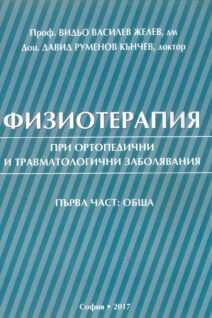

Physiotherapy in orthopedic and traumatological diseases. Part one: general
Original price was: 18.92 €.16.87 €Current price is: 16.87 €.
ISBN: 9786191609000
Автор: Видьо Желев, Давид Кънчев
Publisher:Avangard Prima
Year of release: 2019
Volume: 170 pages.
Size:20.5/29cm
Covers: softcover
Out of stock
Physiotherapy in orthopedic and traumatological diseases. Part one: general
1. WHAT IS ORTHOPAEDICS? – V. Zhelev, D. Kanchev 15
1.1. Classification of orthopedic diseases 16
1.2. Examination and assessment of an orthopedic patient conducted by a physiotherapist 16
1.3. Basic treatment methods in orthopedics: 17
2. ENGINE-D. Kanchev, V. Zhelev 18
2.1. Tissues of living organisms 18
2.2. Human skeleton 20
3. MUSCULOSKOLE INJURIES – V. Zhelev, D. Kanchev 33
3.1. Causes and injuries of the musculoskeletal system 33
3.2. Impaired functions 34
3.3. Tissue healing 35
3.4. Основни методи на лечение при травмите на опорно-двигателния апарат 39
3.4.1. Неоперативно лечение на закритите фрактури 39
3.4.2. Surgical treatment of bone fractures 39
3.4.3. Phases and periods of the disease process. Phases and periods of physiotherapy application 41
Physiotherapy in orthopedic and traumatological diseases. Part one: general
4. ASEPTIC INFLAMMATION AFTER SOFT TISSUE INJURY. APPLICATION OF PHYSIOTHERAPY – D. Kanchev, V. Zhelev 43
4.1. Acute phase (phase of the reflex inflammatory reaction) 43
4.2. Subacute phase (healing phase) 44
4.3. Chronic phase (maturation and remodeling phase) 44
5. ПРОМЕНИ В ТЪКАНИТЕ ВСЛЕДСТВИЕ НА ИМОБИЛИЗАЦИЯТА И ВЪЗДЕЙСТВИЕТО НА ФИЗИОТЕРАПИЯТА ЗА ПРЕОДОЛЯВАНЕТО ИМ – В. Желев, Д. Кънчев 45
5.1. Changes in muscle tissue during immobilization. Effects of physiotherapy after removal of immobilization 46
5.2. Changes in joints and periarticular tissues during immobilization. Effects of physiotherapy 49
5.3. Changes in bone tissue during immobilization. Physiotherapy after removal of immobilization 52
6. FUNCTIONAL METHODS FOR RESEARCH, MEASUREMENT AND ASSESSMENT IN ORTHOPEDIC AND TRAUMATOLOGICAL DISEASES OF THE MUSCULOSKOLE SYSTEM – D. Kanchev, V. Zhelev 55
1. Basic requirements 55
2. Research in physiotherapy for diseases and injuries of the musculoskeletal system 55
3. Analysis of functional studies and measurements 56
4. Determining the rehabilitation potential 57
Методи за определяне на физическото развитие на the person 58
1. Somatoscopy 58
2. Anthropometry 61
2.1. Morphological anthropometric data 61
2.2. Functional data 6
2.3. Measurement of spinal deformities 65
2.4. Measurement of lower limb deformities 67
2.5. Methods for determining the degree of flatfoot 69
2.6. Measuring ankle swelling 70
MEASURING THE VOLUME OF MOVEMENT IN THE JOINTS WITH A PROPHYR 71
TESTS FOR DETERMINING THE DEGREE OF PAIN V. Zhelev 76
1. Тест за болка на Мерл 0’Добине 76
2. Routine pain test 77
3. Visual Analogue Scale (VAS) for pain 77
MEASURING MUSCLE WEAKNESS, STRENGTH AND ENDURANCE 78
1. Manual muscle testing 78
2. Measuring the strength and endurance of muscle groups in seconds 78
3. Measuring hand grip strength 79
4. Examination and evaluation of hand grip 80
GAIT TEST FOR MUSCULOSKOLE INJURIES 86
TESTS FOR ASSESSING STATIC AND DYNAMIC POSTURE BALANCE 88
1. Updated test for assessing balance, coordination and static physical activity (D. Kanchev, 2015) 88
2. Test for assessing static, dynamic balance and posture control (D. Kanchev, 2016) 897. INFLUENCE OF PHYSIOTHERAPY ON DISEASE CHANGES IN ORTHOPAEDIC AND TRAUMATIC DISEASES OF THE MUSCULOSKOLE SYSTEM – V. Zhelev, D. Kanchev 95
1. Limited range of motion in joints 95
2. Physiotherapy to restore range of motion in joints 97
8. PHYSIOTHERAPY TOOLS USED IN ORTHOPAEDIC AND TRAUMATOLOGICAL FRACTURES OF THE MUSCULOSKOLE SYSTEM – V. Zhelev, D. Kanchev 98
1. Treatment through position 98
2. Therapeutic massage 98
3. Passive and autopassive exercises for the limbs (S. Kisner, L., Colby, 1996) 99
4. Relaxation and stretching techniques 104
4.1. Postisometric relaxation 105
4.2. Reciprocal innervation 107
4.3. Postreciprocal relaxation (PRR) 108
4.4. Postfacilitation Stretch according to V. Janda (PFS – Postfeacilitation Stretch, V. Janda, 1991) 109
4.5. Eccentric stretching 110
4.6. Autostretching 110
4.7. Selection of applied muscle inhibitory techniques 112
6. Cryotherapy 118
7. Active exercises 122
7.1. Exercises from a relaxed starting position 122
7.2. Analytical exercises 123
7.3. Weight-bearing exercises 123
7.4. Isometric exercises 129
7.5. Coordination, agility and sensorimotor stimulation exercises 129
7.6. Упражнения с швейцарска топка (Swiss-Ball) по В. Желев и Е. Лиану, 2001 131
7.7. Training in walking with assistive devices 132
Physiotherapy in orthopedic and traumatological diseases. Part one: general
8. Restoring muscle strength and endurance 133
8.1. General data and methodology for restoring and increasing muscle strength 133
a/ General data 133
b/ Methodology for restoring and increasing muscle strength 134
8.2. Methods for increasing muscular strength and endurance 139
a/ Isometric methods 139
Isometric gymnastics 139
– Isometric methodology by St. Bankov and R. Genchev 140
– Isometric methodology by D. Rose 140
-Isometric method by E.A. Muller (1970) 141
b/ Isotonic method – by Delorme, Watkins 141
8.3. Basic characteristics and requirements for restoring and increasing muscle strength of the limbs 141
a) Basic requirements for muscle strength recovery 142
b) Methods of resistance 143
c) Methodology for restoring muscle strength of the limbs by V. Zhelev, K. Ivanov (1984) 143
8.4. Development of strength endurance 146
9. PHYSIOTHERAPY FOR MUSCULOSKOLE INJURIES – D. Kanchev 150
1. Impact of physiotherapy and requirements for its application in musculoskeletal injuries 150
2. Physiotherapy for soft tissue injuries 151
a) Physiotherapy in the acute phase of soft tissue injuries – inflammation phase 152
b) Physiotherapy in the subacute phase of soft tissue injuries – controlled movement phase 154
c) Physiotherapy in the chronic phase of soft tissue injuries – functional recovery phase 157
10. PHYSIOTHERAPY IN NON-SURGICAL TREATMENT OF FRACTURES - D. Kanchev, V. Zhelev 159
a) Physiotherapy during the immobilization period 160
b) Physiotherapy in the early post-immobilization period 162
c) Physiotherapy in the late post-mobilization period 164
11. PHYSIOTHERAPY IN SURGICAL TREATMENT OF FRACTURES - V. Zhelev, D. Kanchev 165
2. Postoperative period 166
a) Maximum sparing (early) postoperative period 166
Clinical symptoms 166
b) Moderately sparing (basic) postoperative period 167
c) Slightly sparing (late) postoperative period 168
Literature 169
- Physiotherapy for orthopedic and traumatological diseases.
- First part: general
| Origin | Bulgarian |
|---|---|
| ISBN | 9786191609000 |
| Author | |
| Publisher |
Related products


Anatomy
Sinelnikov - Atlas of Human Anatomy - Volume 2 (Learning about internal organs and endocrine glands)